From Wobbles to Wins from georgetown to new braunfels texas beyond Kids Build Resilience Through Physical Equilibrium
Here's what resilience actually looks like: a kid wobbles on a balance board, arms windmilling, face scrunched in concentration. They tip too far left. Their foot slips. They catch themselves, or they don't, and they hop off laughing or frustrated or determined. Then they step back on and try again.
That's it. That's the whole lesson.
And it's one of the most powerful SEL activities for kids we've found in our work across Austin, Round Rock, Pflugerville, Cedar Park, and the rest of Central Texas. Not because balance boards are magic, but because they give kids something school assemblies and worksheets rarely do: a physical, repeatable experience of falling and choosing to get back up.
If you're a parent, teacher, or program director searching for holistic youth development tools that actually translate to real life, this is the honest story of how physical equilibrium builds emotional resilience, and why Central Texas kids are showing up differently after they practice it.
What We Mean by "Physical Equilibrium" (And Why It Matters for Youth Mental Health)
Let's start with what we're NOT talking about. This isn't about training future Olympic gymnasts or creating perfectly coordinated athletes. Physical equilibrium, balance, is about your body's ability to sense where it is in space, make micro-adjustments, and stay upright even when the surface beneath you shifts.
For kids, that skill goes way beyond the balance board. It shows up when:
They're navigating a crowded hallway at school and someone bumps into them
They trip on the playground and don't faceplant
They're learning to skateboard, ride a bike, or dance
They're sitting still long enough to focus in class (yes, balance affects attention)
But here's where it gets interesting for youth mental health programs: the same neurological systems that help kids balance physically are also involved in emotional regulation. When a child practices staying steady on an unstable surface, their brain is learning to manage unpredictability, and that lesson carries over into how they handle stress, disappointment, and challenge off the board.
We've seen it happen in our mobile sessions across South Austin, Georgetown, Leander, Manor, and Hutto. A kid who freezes up when they feel overwhelmed will practice balancing, wobbling, catching themselves, and over weeks, they start applying that same "I can steady myself" mindset to social situations, schoolwork, and family conflict.
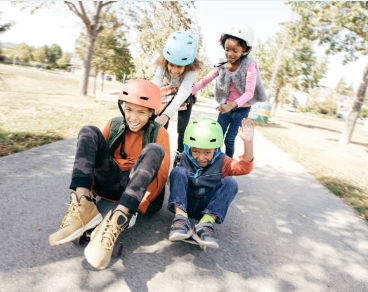
The Fall-and-Rise Cycle: How Balance Training Becomes a Resilience Metaphor
This is where the "wobbles to wins" idea really lands. When a young person steps onto a balance board or surfskate for the first time, they're going to wobble. They might fall. They'll definitely feel uncertain. And in that moment, they have a choice:
Get frustrated and give up
Blame the equipment, the ground, the instructor, their body
Take a breath, reset, and try again
That choice is resilience in action. And it happens dozens of times in a single 45-minute session.
What makes balance training such a powerful tool for SEL activities for kids is that it's low-stakes practice for high-stakes life skills. Nobody's grading them. There's no "right" way to wobble. The board doesn't care if they fell yesterday or if their best friend is better at it. It just asks: are you going to step back on?
We structure our SwellSync™ Framework to honor this cycle. Our sessions aren't about perfection, they're about repetition, self-awareness, and the tiny confidence boost that comes every time a kid steadies themselves one second longer than they did before.
The Four SwellRise™ Tracks (And How They Build Resilience Together)
At KV33 Swell, we don't just hand kids a board and say "good luck." Every session flows through our SwellRise™ Tracks, designed to give youth multiple entry points into building resilience:
CREATE Track – Surf-inspired movement (surfskate + balance board) + creative expression + coordination challenges. This is where the falling and rising happens most visibly. Kids build body awareness, spatial confidence, and the grit that comes from trying something difficult.
RESTORE Track – Breath practices, grounding exercises, and (for ages 9+, depending on group readiness) sound-based calming with crystal singing bowls. This is where we help kids notice what "steady" feels like inside their body, not just on the board.
HARMONY Track – Partner challenges, teamwork activities, and community connection moments. Resilience isn't just individual, it's also about knowing you have people who've got your back when you wobble.
INSPIRE Track – Non-movement reflection, SEL mini-lessons, creative journaling or discussion prompts. This is where we name what they just practiced: "You fell three times and got back on. What does that tell you about yourself?"
This isn't a rigid schedule, sessions are flexible and youth-responsive. But the framework ensures that whether we're at a school in West Lake Hills, a rec center in Elgin, or a nonprofit site in Kyle, kids are getting a full-spectrum experience that teaches resilience through body, breath, connection, and reflection.
What a Session Actually Looks Like (Spoiler: It's Fun, Not Clinical)
Let's walk through a typical 45–60 minute session so you can picture what your school, organization, or child would actually experience.
Arrival + Check-In (5 min)
We roll up with all the gear: balance boards, surfskates, safety equipment (helmets, pads), sound bowls, art supplies. Kids choose their gear, get fitted for helmets, and we do a quick body/energy check-in. "How are you feeling today? What's one word for your energy right now?"
Warm-Up + CREATE (15–20 min)
Movement time. We start with grounded balance work, standing on one foot, wobble boards, basic surfskate pushing. Beginner-friendly, no pressure. Some kids take to it immediately. Others wobble like crazy and giggle. Both are perfect. We're building coordination, proprioception (body awareness), and confidence through repetition.
Challenge + HARMONY (10–15 min)
Now we layer in partner activities or group challenges. "Can you pass this ball while balancing?" "Can you and a friend mirror each other's movements?" This is where resilience becomes social, they're learning to steady each other, celebrate small wins together, and recover from wobbles as a team.
RESTORE + Breath (5–10 min)
We bring the energy down. Depending on the group, this might be a seated grounding practice, a breathing exercise, or (for older/ready groups) a short sound immersion with crystal bowls. We're teaching kids that "steady" isn't just about physical balance, it's also about finding your center when your nervous system is activated.
INSPIRE + Reflection (5 min)
We close with a quick circle. "What was hard today? What surprised you? What did you learn about yourself?" This is where the metaphor becomes explicit. You fell. You got back up. That's resilience. You just practiced it.
We serve youth ages 5–17 across Austin and Central Texas, and the sessions scale to developmental stage. Younger kids get more movement, less sitting. Teens get more reflection and challenge. But the core cycle, wobble, fall, rise, repeat, stays the same.
Who We Serve + Where We Show Up
KV33 Swell is a mobile, founder-led nonprofit. That means we bring everything to you, gear, safety equipment, trained facilitation, and a trauma-aware approach that centers youth voice and readiness.
We work with:
Schools – Enrichment programs, PE integration, SEL support, campus wellness days, after-school programming (public, charter, private, Title I)
Cities + Parks & Rec Departments – Youth programming, community classes, family wellness events
Nonprofit Partners – Contracted programming, pilot collaborations, youth development initiatives
Private Families – Small-group sessions, birthday experiences, homeschool co-op enrichment
Current service area includes:
Austin (South Austin, East Austin, West Austin, North Austin), Round Rock, Cedar Park, Pflugerville, Georgetown, Leander, Manor, Hutto, Kyle, Buda, Lakeway, Bee Cave, Dripping Springs, Elgin, West Lake Hills, and surrounding Central Texas communities.
If you're outside this radius, reach out, we're growing and may be able to coordinate a series if there's enough interest in your area.
Why This Actually Works (The Mechanisms Behind the Metaphor)
Balance training isn't just a cute metaphor. There's real developmental science here (though we're not making medical claims, this is about supporting skills, not treating conditions):
And if you’re the kind of Austin-area parent/educator who’s like, “Cool story… but does this actually translate?”—that’s fair. Research on movement-based, balance-forward programming shows real, measurable shifts for a lot of participants.
A large review of youth self-regulation interventions found that about 60% of participants showed reliable, measurable improvements in self-regulation and attention—which is a pretty solid backup for the whole “practice wobbling, practice bouncing back” resilience metaphor. Source: JAMA Pediatrics (Pandey et al., 2018) https://jamanetwork.com/journals/jamapediatrics/fullarticle/2677898
In a multisensory + motor program study including 316 youth, researchers reported significant cognitive gains in just 3 months (including areas like attention/working memory measures in that program’s testing). Source: Frontiers in Child and Adolescent Psychiatry (Jackson & Meng, 2024) https://www.frontiersin.org/journals/child-and-adolescent-psychiatry/articles/10.3389/frcha.2024.1450695/full
Vestibular System Activation
The inner ear system that controls balance also plays a role in attention, spatial awareness, and sensory integration. When kids challenge their balance, they're activating neural pathways that help them "feel organized" in their body.
Repetition Without Judgment
Every wobble is data, not failure. Kids practice self-correction dozens of times per session in a context where there's no grade, no performance pressure, no comparison. That builds a growth mindset faster than any poster on a classroom wall.
Proprioceptive Feedback
Balance work teaches kids where their body is in space. That body awareness translates to better self-regulation, kids who know what "grounded" feels like physically can more easily recognize when they're dysregulated emotionally.
Safe Risk-Taking
Falling off a balance board (with a helmet on, on a soft surface, with a trained adult nearby) is a low-consequence risk. It teaches kids that they can handle uncertainty, make mistakes, and be okay. That's the foundation of resilience.
Community Witness
When kids wobble and recover in front of their peers, and those peers cheer instead of laugh, something shifts. They learn that struggle isn't shameful, it's shared. That sense of belonging is protective.
We don't claim to "fix" kids or "cure" anxiety. But we do see kids walking taller, trying harder things, and handling setbacks differently after they've spent time in our programs. That's what holistic youth development looks like in practice.
What Partners Receive (If You Bring KV33 to Your School or Org)
Wondering what a partnership actually includes? Here's what you get:
✅ Full Mobile Setup – We bring all equipment (balance boards, surfskates, safety gear, sound bowls, art supplies)
✅ Founder-Led Sessions – Trained, background-checked facilitation with trauma-aware practices
✅ Small Group Ratios – Max 8–12 youth per session for safety and quality connection
✅ Flexible Scheduling – One-time wellness days, 4–8 week series, ongoing enrichment
✅ Customizable Programming – We adapt to your population's needs and developmental stage
✅ Safety-First Approach – All youth wear helmets + pads; we follow strict safety protocols
✅ Privacy-Forward Content Policy – No real-time location posting, no faces shared without signed consent
✅ Post-Pilot Debrief – Feedback session to assess impact and discuss continuation
What a Pilot Looks Like:
Most partners start with a 4-session pilot (once a week for a month, 45–60 min each). That gives kids enough repetition to experience the "fall and rise" cycle multiple times and for facilitators to see patterns in engagement and growth. After the pilot, we'll talk about what worked, what to adjust, and how to continue or scale.
What Sponsorship + Donations Fund
KV33 Swell operates as a 501(c)(3) nonprofit, which means we rely on community support to keep programs accessible. Here's what your sponsorship or donation makes possible:
Equipment + Safety Gear – Balance boards, surfskates, helmets, pads, sound bowls
Subsidized Program Access – Scholarships for families who can't afford private sessions; sliding scale for nonprofits
Bringing Programs to Underserved Youth – Partnerships with Title I schools, Boys & Girls Clubs, housing authority programs
Trained Facilitation – Founder time, assistant facilitator stipends, ongoing training in trauma-aware practices
Program Delivery Costs – Transportation, setup, insurance, administrative operations
Sponsor recognition options include:
Logo on our website partner page, social media shout-outs (with your approval), mention in our newsletter, and impact reporting (we'll share anonymized stories of how your support made a difference).
Interested in sponsoring a series? Let's talk.
Frequently Asked Questions
What ages do you serve?
We work with youth ages 5–17. Sessions are developmentally adapted, younger kids get more movement and play, older youth get more challenge and reflection.
Where do you operate?
We're based in Austin and serve the greater Central Texas area, including Round Rock, Cedar Park, Pflugerville, Georgetown, Leander, Manor, Hutto, Kyle, Buda, Lakeway, Bee Cave, Dripping Springs, Elgin, West Lake Hills, and surrounding communities. If you're nearby but not on this list, reach out, we're expanding.
What's the class size cap?
For safety and quality, we cap sessions at 8–12 youth depending on age and space. Smaller groups mean more individualized support and better community connection.
What safety gear do you provide?
All youth wear helmets and protective pads (wrist guards, elbow pads, knee pads) during movement activities. We bring all equipment and fit each participant before they step on a board.
Do you post photos of kids online?
Not without explicit, signed consent. Our default policy is privacy-forward, we don't share kids' faces or real-time locations. If a partner or family wants to opt in to content sharing, we have a clear consent process.
How do I request a pilot or book a session?
Use the "Request a Pilot" button on our site, or reach out through our website contact page with: your organization name, location, approximate number of youth, preferred days/times, and any specific population needs (e.g., sensory-sensitive group, alternative school setting, etc.). We'll schedule a quick call to make sure we're a good fit.
Contact us here: https://www.kv33swell.org
How do sponsors get recognized?
We offer logo placement on our website, social media mentions, newsletter features, and impact reports. Recognition is always done with your approval, you control how visible you want to be.
Is this therapy or a mental health treatment?
No. KV33 Swell is not a licensed mental health provider, and our programs are not therapy. We offer youth development programming that may support skills like self-regulation, confidence, and resilience: but we don't diagnose, treat, or make clinical claims. If a young person needs mental health support, we encourage families to connect with licensed providers.
What does a typical pilot include?
Most pilots are 4 weekly sessions (45–60 min each) with the same group of 8–12 youth. That gives kids time to build familiarity, see their own progress, and experience the full SwellSync™ Framework. After the pilot, we debrief with your team and talk about continuation options.
How to Get Started (Three Simple Steps)
1. Reach out.
Hit the "Request a Pilot" or "Book a Call" button. Tell us about your organization, your youth population, and what you're hoping to support.
2. Quick planning call.
We'll hop on a 15-minute call to talk logistics: dates, group size, space requirements, any special accommodations.
3. We roll up with everything.
On day one, we bring the gear, the safety equipment, the trained facilitation, and the framework. You bring the kids. We'll take it from there.
Ready to Bring "Wobbles to Wins" to Your Community?
If you're a school administrator in Cedar Park looking for an SEL enrichment option that doesn't add to teacher burnout, we're here.
If you're a rec director in Round Rock wanting fresh youth programming that's more than just sports, let's talk.
If you're a nonprofit leader in South Austin serving kids who need confidence-building tools and a place to belong, we'd love to partner.
And if you're a parent in Georgetown or Pflugerville who wants your child to experience what resilience actually feels like (not just what it sounds like in a lecture), we offer small-group private sessions too.
The balance board is just a board. But what kids learn on it: that they can fall, steady themselves, and choose to try again: that's the skill that changes everything.
Request a Pilot | Book a Call | Sponsor a Series | Host a Class at Your Site | Bring KV33 to Your School | Donate to Expand Access
