The Future of Austin Classrooms: Why Physical Balance is the New Foundation for SEL
Walk into any Austin-area classroom today, from West Lake Hills to Cedar Park, Round Rock to East Austin, and you'll see something interesting happening. Schools are redesigning spaces with flexible seating, learning stairs, and collaboration zones. Districts are investing in social emotional learning programs and wellness initiatives. Counselors are implementing SEL activities for kids that focus on self-awareness, relationship skills, and responsible decision-making.
But here's what most school wellness programs are missing: the body.
Specifically, the vestibular system, your inner ear's balance center that directly influences emotional regulation, attention, focus, and the ability to stay calm under stress. While we've been focusing on teaching kids about their emotions through curriculum and conversation, we've been skipping the physical foundation that makes emotional regulation actually possible.
That's about to change. And it's happening right here in Central Texas.
Austin Schools Are Evolving, But There's a Missing Piece
According to recent Austin ISD design initiatives, modern school spaces are prioritizing student well-being through intentional design. The new three-story middle school in northeast Austin supports "interdisciplinary, project-driven learning" while serving as a community hub. Burnet Middle School's replacement (opening fall 2027) will celebrate diversity and inclusivity through thoughtful spatial design.
These are incredible steps forward. Student commons areas encourage both collaboration and informal connection. Learning stairs redefine hallways into versatile gathering spaces. Flexible media centers combine collaborative seating with quiet zones.
But here's the honest question: can a kid who's dysregulated, anxious, or overstimulated actually use those beautiful flexible spaces effectively?
Not without the neurological foundation to self-regulate first.
The Science Is Clear: Balance Training Rewires the Developing Brain
Your vestibular system, the sensory system responsible for balance and spatial orientation, is deeply connected to the parts of your brain that manage emotional regulation, attention, impulse control, and stress response.
And the research is pretty loud on this: a major study found coordination-based exercise (think balance training, agility, complex movement patterns—aka exactly the kind of “stay steady while things shift” practice we do) showed an effect size of 0.89 on executive function development—outperforming traditional team sports (0.72) and even aerobic exercise (0.76). That’s a big deal for schools trying to support attention, planning, and self-control in real life—not just on paper.
Source: https://bjsm.bmj.com/content/53/10/640
When a young person practices physical balance (like standing on a balance board, navigating a surfskate, or holding a challenging yoga pose), they're not just building core strength. They're activating their prefrontal cortex, the executive function center responsible for planning, decision-making, and emotional control. They're also strengthening the connection between their cerebellum (movement coordination) and their limbic system (emotional processing).
Here's what that looks like in real life:
A 4th grader in Pflugerville who used to melt down during transitions learns to notice when their body feels "wobbly" emotionally, and uses breath to recenter before the big feelings take over.
A middle schooler in Georgetown who struggles with impulsivity discovers that the same focus required to balance on a moving board translates to pausing before reacting in conflict.
A high schooler in Lakeway dealing with test anxiety realizes that the rhythm and repetition of movement practice creates a sense of calm they can access before walking into an exam.
This isn't abstract. This is measurable, observable skill-building happening through the body.
And it's exactly what KV33 Swell brings to schools across Austin and Central Texas through our mobile social emotional learning program.
Meet the SwellSync™ Framework: Where Movement Meets SEL
At KV33 Swell, we don't just teach kids how to balance on a board. We use surf-inspired movement as the gateway to nervous system regulation, confidence-building, creative expression, and genuine community connection.
Our SwellSync™ framework is built on four experiential tracks, what we call the SwellRise™ Tracks, that work together to support the whole young person:
CREATE (Movement + Creativity + SEL)
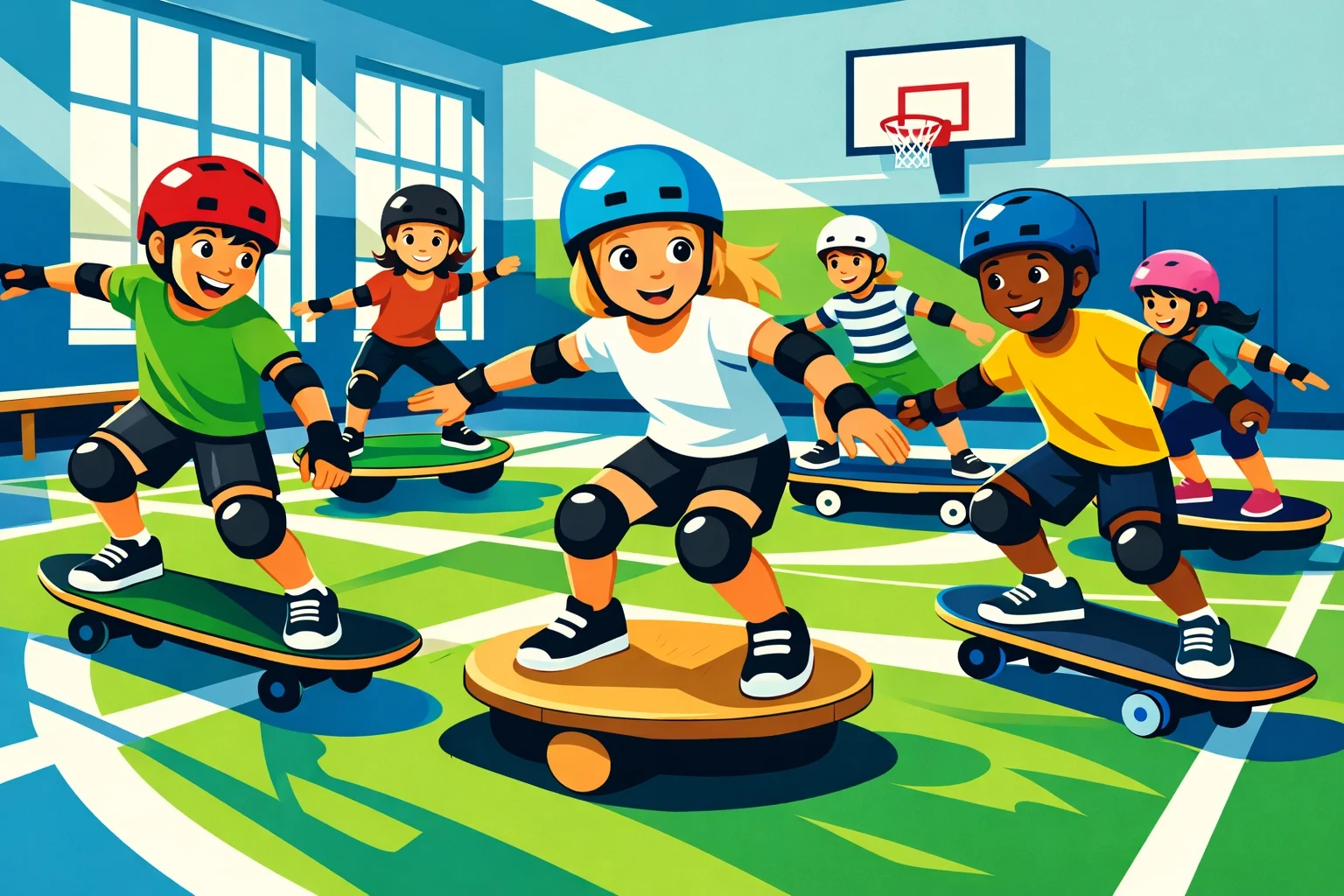
This is where we start: beginner-friendly surfskate and balance board training that meets kids exactly where they are. No prior experience needed. We bring all the gear (boards, helmets, pads) and safety equipment directly to your school, rec center, or community space.
Every movement session includes:
Body awareness check-ins ("Where do you feel this challenge in your body?")
Micro-SEL moments woven into the activity (talking about perseverance when someone falls, celebrating peer encouragement, naming frustration and using breath to reset)
Creative expression through movement exploration (there's no "one right way" to ride, we encourage individual style and experimentation)
RESTORE (Regulation + Breath + Sound-Based Calming)
After movement, we guide students into restorative practices designed to help their nervous systems integrate what they just learned. For older youth (typically ages 9+), this often includes sound immersion using crystal singing bowls, chimes, and other therapeutic instruments.
Younger students might engage in:
Guided breathwork and body scans
Grounding exercises
Reflection prompts ("What did you notice about your focus today?")
This is where we explicitly teach self-regulation skills, not as a lecture, but as a felt experience in the body.
HARMONY (Connection + Teamwork + Confidence)
SEL activities for kids work best when they happen in relationship. During our sessions, students practice:
Encouraging peers who are trying something challenging
Celebrating small wins together (we make a big deal out of effort, not just success)
Navigating frustration and conflict in a supportive, low-stakes environment
Building a sense of belonging through shared experience
Many kids tell us our sessions are the only place at school where they feel like they can truly be themselves, wobbly, imperfect, and still completely supported.
INSPIRE (Reflection + SEL + Creative Expression)
This is our non-movement track, where we pull it all together. Through creative prompts, journaling, group discussion, or art-making, students reflect on what they're learning about themselves, their emotions, and their relationships.
Questions we explore:
"What does confidence feel like in your body?"
"How do you know when you need to reset?"
"What's one tool you used today that you could use outside of this space?"
This is the bridge from the session to real life. This is where kids begin to see that the skills they're building on a balance board translate directly to managing stress in the hallway, advocating for themselves with a teacher, or navigating friendship conflict at lunch.
What This Looks Like in Your Austin-Area School
Let's get specific. Here's what a pilot session or ongoing series with KV33 Swell actually looks like:
Before we arrive:
We coordinate with your school admin, PE coordinator, counselor, or after-school program lead to determine the best space (gym, blacktop, cafeteria, outdoor court, we're flexible).
We confirm group size (we cap sessions at 12 students to maintain safety and quality).
We gather any necessary waivers and communicate with families.
What we bring:
All surfskate boards and balance boards (beginner-friendly equipment)
All safety gear (helmets, wrist guards, knee pads, elbow pads)
Sound immersion instruments (for RESTORE track with older students)
Our founder-led, trauma-aware facilitation (we're not just dropping off equipment, Emily shows up and leads every session with intention)
What a 60-minute session includes:
Welcome circle and body check-in (5 min)
Safety briefing and equipment intro (5 min)
Guided movement practice with embedded SEL moments (30 min)
RESTORE track: breathwork, sound, or grounding (10 min)
INSPIRE track: reflection and closing circle (10 min)
What you receive after:
Brief session summary
Observations about student engagement and growth areas
Recommendations for continued support or next steps
No real-time social media posting. No photographing students' faces without explicit parent consent. We're privacy-forward in everything we do because trust and safety come first.
Serving Austin + Central Texas: Where We Show Up
KV33 Swell is a fully mobile youth wellness program serving students ages 5–17 across the greater Austin area and Central Texas. We bring our school wellness program directly to your campus, rec center, nonprofit space, or community location.
We currently serve:
Travis County: Austin (including East Austin, South Austin, North Austin), West Lake Hills, Lakeway, Bee Cave, Sunset Valley, Rollingwood
Williamson County: Round Rock, Cedar Park, Georgetown, Leander, Pflugerville, Hutto, Taylor
Hays County: Buda, Kyle, San Marcos, Dripping Springs
Bastrop County: Bastrop, Elgin
And surrounding Central Texas communities where there's interest in bringing movement-based SEL programming to youth.
Don't see your city listed? Reach out anyway. We're actively expanding our service area and can often accommodate new locations, especially for school districts or city recreation departments interested in piloting a series.
What Partners Receive: More Than Just a "Wellness Day"
When schools, nonprofits, or recreation departments partner with KV33 Swell, you're not just checking a box on your SEL enrichment program list. You're investing in a research-informed, trauma-aware youth program that delivers measurable skill-building in a way students actually enjoy.
Zooming out, the research on SEL outcomes is strong too: students who participate in evidence-based SEL programs show an average 11 percentile-point gain in academic achievement. That’s not about “more pressure” on kids—it’s what happens when you give students real tools for self-management, focus, and connection so they can actually access learning.
Source: https://casel.org/fundamentals-of-sel/what-does-the-research-say/
Here's what you get:
✅ Founder-led delivery (Emily brings 10+ years of youth development experience and shows up fully present for every session)
✅ All equipment and safety gear (no need to purchase or store anything)
✅ Flexible scheduling (one-time wellness days, 4-week pilots, ongoing semester series, after-school enrichment)
✅ Alignment with CASEL's 5 SEL competencies (self-awareness, self-management, social awareness, relationship skills, responsible decision-making)
✅ Adaptable to diverse learners (we support neurodivergent students, highly sensitive kids, reluctant movers, high-energy youth, everyone is welcomed exactly as they are)
✅ Coordination support (we handle logistics, waivers, and communication so you don't have to add to your already-full plate)
Interested in piloting? A typical 4-week pilot includes four 60-minute sessions with the same group of students, allowing us to track progress and build genuine relationships. By week four, the transformation is visible: kids are more confident, more regulated, and more connected to their peers.
Want us at your campus? Request a Pilot
What Sponsorship and Donations Fund: Breaking Down Barriers to Access
Here's the reality: not every school has discretionary funds for enrichment. Not every family can afford private youth sessions. And the students who would benefit most from movement and mindfulness programs are often the ones with the least access.
And if you’re wondering whether SEL is “worth investing in” at a community level—research commonly cited from Columbia University has found that for every $1 invested in SEL programs, there’s an $11 return in long-term benefits (things like improved outcomes that ripple out into the broader community). That’s why we take sponsorship so seriously here in Austin—it’s not charity, it’s smart community infrastructure.
Source: https://www.wallacefoundation.org/knowledge-center/pages/sel-benefits-costs.aspx
That's why KV33 Swell operates as a 501(c)(3) nonprofit, and why community sponsorship and donations are critical to our mission.
When you sponsor a KV33 series or make a donation, you fund:
Equipment and safety gear (surfskate boards, helmets, pads, balance boards, sound instruments)
Subsidized and scholarship spots for students whose families can't afford private sessions
Program delivery to underserved communities (Title I schools, community centers serving low-income youth, nonprofit partners working with vulnerable populations)
Trauma-aware facilitation training (we don't just show up and teach tricks, we show up prepared to hold space for complex emotions and varied needs)
Bringing programs directly to where youth already are (no transportation barriers, no "one more thing" for overwhelmed families to coordinate)
Corporate partners and local businesses: your sponsorship doesn't just fund a program. It funds belonging, confidence, and regulation skills for young people who might not otherwise have access to this kind of support.
Ready to sponsor a series? Book a Call
Frequently Asked Questions
What ages do you serve?
We work with youth ages 5–17. Our approach is adapted to be developmentally appropriate for each age group. Younger kids (5–8) focus more on foundational balance and creative play. Older students (9–17) engage in more complex movement challenges, deeper SEL reflection, and optional sound immersion experiences.
Where do you offer programs?
We're fully mobile and serve the greater Austin area and Central Texas, including Travis, Williamson, Hays, and Bastrop Counties. We come to schools, recreation centers, nonprofit spaces, and community locations. If you're outside our typical service area, reach out, we may be able to accommodate.
What's your class size cap?
We cap sessions at 12 students to maintain safety, quality, and the ability to provide individualized support. Small group sizes allow us to notice when a student is struggling and offer real-time encouragement or modification.
What safety measures do you have in place?
Safety is non-negotiable. We provide all helmets, wrist guards, knee pads, and elbow pads. We use beginner-friendly equipment designed for stability. Emily is trained in youth safety protocols and trauma-informed facilitation. We teach falling techniques and body awareness from day one. Every session starts with a safety briefing.
What's your content and privacy policy?
We do not post real-time locations or show students' faces on social media without explicit parent consent. Any photos or videos used for marketing are either stock images, images of our founder/adult participants, or photos taken with signed media releases from families who opted in. Student privacy and family trust are foundational to our work.
How do we request a pilot or book a session?
The easiest way is to fill out our Request a Pilot form on our website or reach out through our contact page: www.kv33swell.org. We'll schedule a quick call to discuss your goals, logistics, and availability. From there, we'll create a customized proposal and timeline.
How are sponsors recognized?
Sponsors are recognized on our website, in email communications to families and partners, and (with permission) in impact reports and social media posts. We're happy to customize recognition based on your preferences and marketing goals.
What does a pilot include?
A typical pilot is a 4-week series with four 60-minute sessions. You'll receive a program overview, session summaries, and a debrief conversation at the end to discuss observations and next steps. Pilots are designed to give you a clear sense of impact before committing to a longer-term partnership.
Is this therapy or a mental health treatment?
No. KV33 Swell is not a licensed mental health provider, and our programs are not therapy. We offer skill-building, community connection, and nervous system regulation tools that may support overall well-being: but we are not a substitute for clinical mental health care. We are happy to coordinate with school counselors or therapists to complement existing supports.
Can neurodivergent students participate?
Absolutely. We welcome and support neurodivergent learners, including students with ADHD, autism, sensory processing differences, and anxiety. Our small group sizes, trauma-aware approach, and flexibility allow us to meet students where they are. Many neurodivergent youth thrive in our sessions because we emphasize individual progress over comparison.
Do students need prior experience with skating or balance boards?
Not at all. Our programs are beginner-friendly and designed for students with zero prior experience. We meet every young person exactly where they are and build from there.
Ready to Bring Physical Balance to Your Austin School?
The future of SEL in Austin classrooms isn't just about curriculum and conversation. It's about giving students the neurological foundation: through movement, balance, breathwork, and connection: to actually use the social-emotional skills we're asking them to develop.
KV33 Swell makes it easy. We bring everything. We handle the logistics. We show up with intention, safety, and a genuine commitment to every young person in the room.
Whether you're a school administrator in Leander exploring enrichment options, a recreation director in San Marcos looking for youth programming that actually engages teens, or a nonprofit leader in East Austin searching for a trauma-aware partner to support your students: we'd love to talk.
How to Get Started:
Reach out: Fill out the Request a Pilot form on our website or contact us here: www.kv33swell.org
Schedule a call: We'll discuss your goals, logistics, group size, and timeline
Launch your pilot: We'll coordinate everything and show up ready to support your students
Options:
Request a Pilot
Book a Call with Emily
Sponsor a School Series
Host KV33 at Your Campus
Bring Movement + SEL to Your School
Schedule a Wellness Day
Partner with KV33 Swell
Donate to Youth Wellness
Learn About Sponsorship
Bring Balance Training to Your Students
integrating movement and mindfulness
SEL enrichment programs in Austin
