Why Every Austin School Wellness Program Should Include Balance Training for Emotional Health
You've probably sat through the same presentation three times this year: another vendor promising to "fix" student regulation with worksheets, posters, or a scripted curriculum your teachers don't have time to implement. Meanwhile, your campus counselor is drowning in Tier 3 referrals, PE teachers are managing 40+ kids at once, and your after-school coordinator is desperately searching for programming that actually keeps students engaged.
Here's what most school wellness programs miss: kids don't regulate on a poster. They regulate through their bodies.
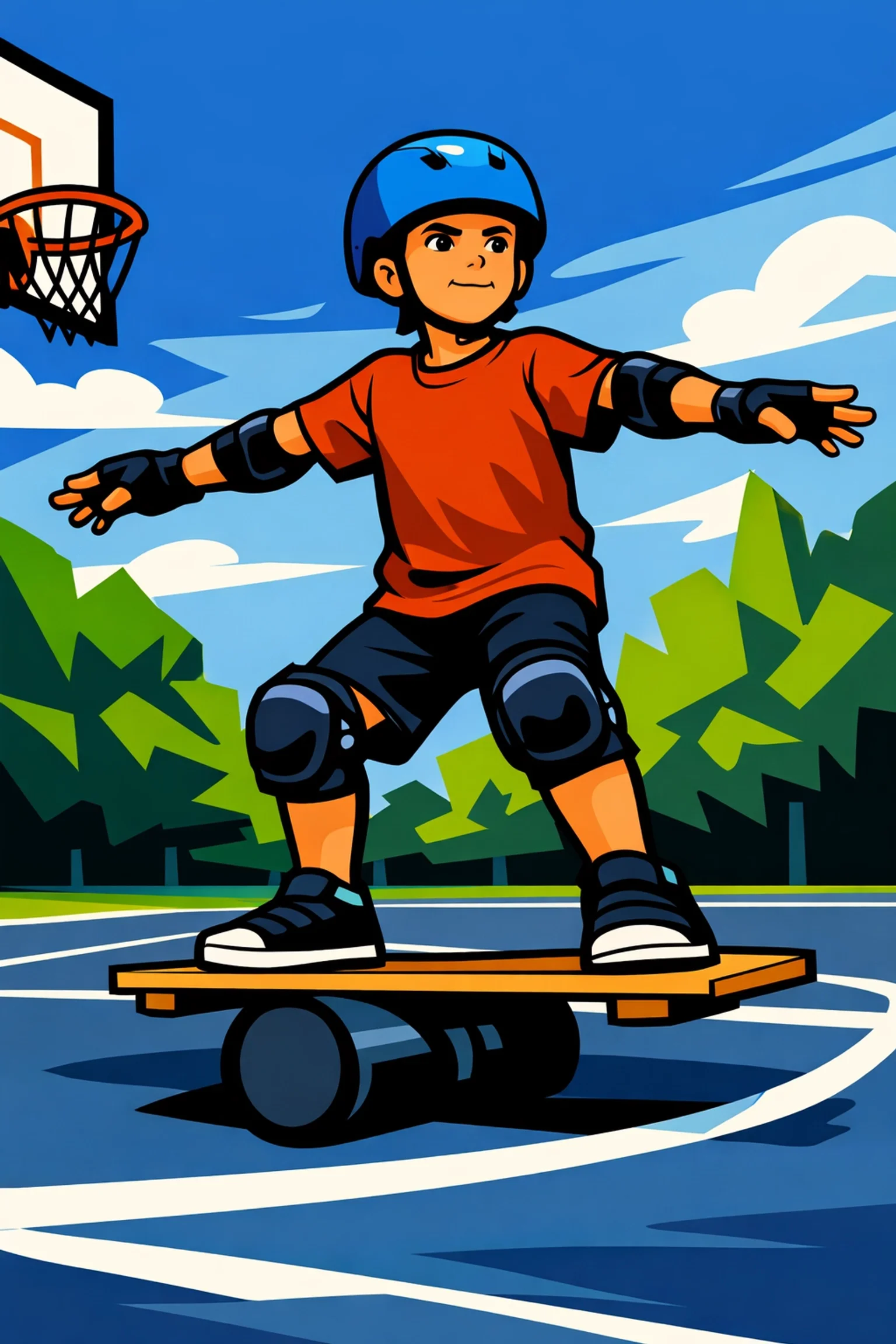
That's where balance training comes in, and no, we're not talking about tightrope walking or gymnastics. We're talking about surf-inspired movement using balance boards and surfskating that build the exact skills your students need to manage big emotions, stay focused in class, and feel confident trying new things.
Let me show you why schools across Austin, Round Rock, Cedar Park, Pflugerville, Georgetown, Leander, Lakeway, Dripping Springs, Kyle, and Buda are adding movement-based emotional health programming to their campuses, and how it fits beautifully into your existing MTSS framework without adding to teacher burnout.
The Problem: Traditional School Wellness Programs Aren't Reaching Enough Kids
You already know the stats. Student anxiety is up. Behavioral referrals are up. Teacher retention is down. And the traditional "pull-out" counseling model can't keep pace with the need.
Multi-Tiered Systems of Support (MTSS) was designed to solve this, by offering Tier 1 universal supports that benefit every student, Tier 2 targeted interventions for at-risk groups, and Tier 3 intensive supports for students in crisis. But here's the thing: most campuses are strong at Tier 3 (you've got counselors, behavior plans, crisis protocols) and weak at Tier 1.
Your Tier 1 school wellness program needs to be:
Accessible to all students (not just the ones who self-select into counseling)
Engaging enough that kids actually want to participate
Evidence-informed (so your district admin doesn't question the ROI)
Low-lift for teachers (because they're already doing the work of three people)
That's exactly what movement-based emotional health programming delivers, and balance training is one of the most effective, underutilized tools in the SEL toolkit.
What KV33 Swell Does: Mobile Balance Training Meets Social-Emotional Learning
KV33 Swell is an Austin-based 501(c)(3) nonprofit that brings holistic youth development directly to your campus. We're fully mobile, meaning we show up with all the gear, all the safety equipment, and a founder-led facilitation model that keeps group sizes small and quality high.
> Important note (trauma-aware + scope): We’re not a licensed mental health provider, and our sessions aren’t therapy. We don’t diagnose, treat, or promise medical outcomes. What we do offer is structured, safety-forward movement + SEL skill practice that can support self-regulation, confidence, and connection—especially as a Tier 1/Tier 2 wellness layer alongside your campus supports.
Here's what a session looks like:
SwellSync™ Framework
Our programming is built on four research-backed tracks that work together:
CREATE Track – Surf-inspired movement (balance boards + surfskates) paired with creative expression and mini SEL lessons. Students build coordination, confidence, and body awareness while learning regulation strategies they can use in the classroom.
RESTORE Track – Breath work, grounding techniques, and (for ages 9+) optional sound immersion using crystal bowls. This teaches students how to activate their own calm when they're overwhelmed.
HARMONY Track – Small-group connection activities that build trust, teamwork, and a sense of belonging. Students practice taking turns, cheering each other on, and celebrating effort over perfection.
INSPIRE Track – Reflection, journaling, and creative expression activities that help students integrate what they've learned and see how these skills show up in their daily lives.
We serve youth ages 5–17, and every session is designed to be beginner-friendly, inclusive, and trauma-aware. No prior experience needed. No risk of public failure. Just a supportive space where students can wobble, laugh, try again, and build the emotional regulation skills they need to thrive.
The Science Behind Balance Training and Emotional Health
Let's talk about why physical balance isn't just a PE skill, it's a nervous system regulation tool.
The Vestibular System Connection
Your vestibular system (the part of your inner ear that controls balance) is directly connected to the parts of your brain that manage emotional regulation, attention, and impulse control. When students practice balancing on a board, they're not just building core strength, they're strengthening the neural pathways that help them stay calm under stress.
Research shows that activities requiring balance and coordination can:
Improve focus and attention span
Reduce hyperactivity and impulsivity
Support self-regulation during emotionally charged moments
Build confidence through achievable physical challenges
And if you’re trying to explain why balance boards aren’t “just recess”—here’s a helpful stat to point to: a meta-analysis reported a large effect (effect size = 0.89) of coordination training on executive function in young children. In other words, coordination-heavy movement can be meaningfully more “brain-building” than free-play movement alone. Source: https://www.sciencedirect.com/science/article/abs/pii/S1755296624000188
Proprioception = Feeling "Grounded"
Proprioception is your body's ability to know where it is in space. Kids who struggle with proprioception often feel "floaty," uncoordinated, or anxious, because their bodies aren't sending clear signals to their brains.
Balance training improves proprioception, which helps students feel more grounded, present, and in control of their bodies. And when your body feels safe, your brain is free to learn, connect, and regulate emotions.
The "Confidence Reps" Effect
Every time a student steps on a balance board, tries, wobbles, and tries again, they're practicing resilience in real time. They're learning that falling isn't failure, it's feedback. That effort matters more than perfection. That they can handle hard things.
These aren't just physical skills. They're life skills that translate directly into the classroom, the cafeteria, and the playground.
How Balance Training Fits Into Your MTSS Model
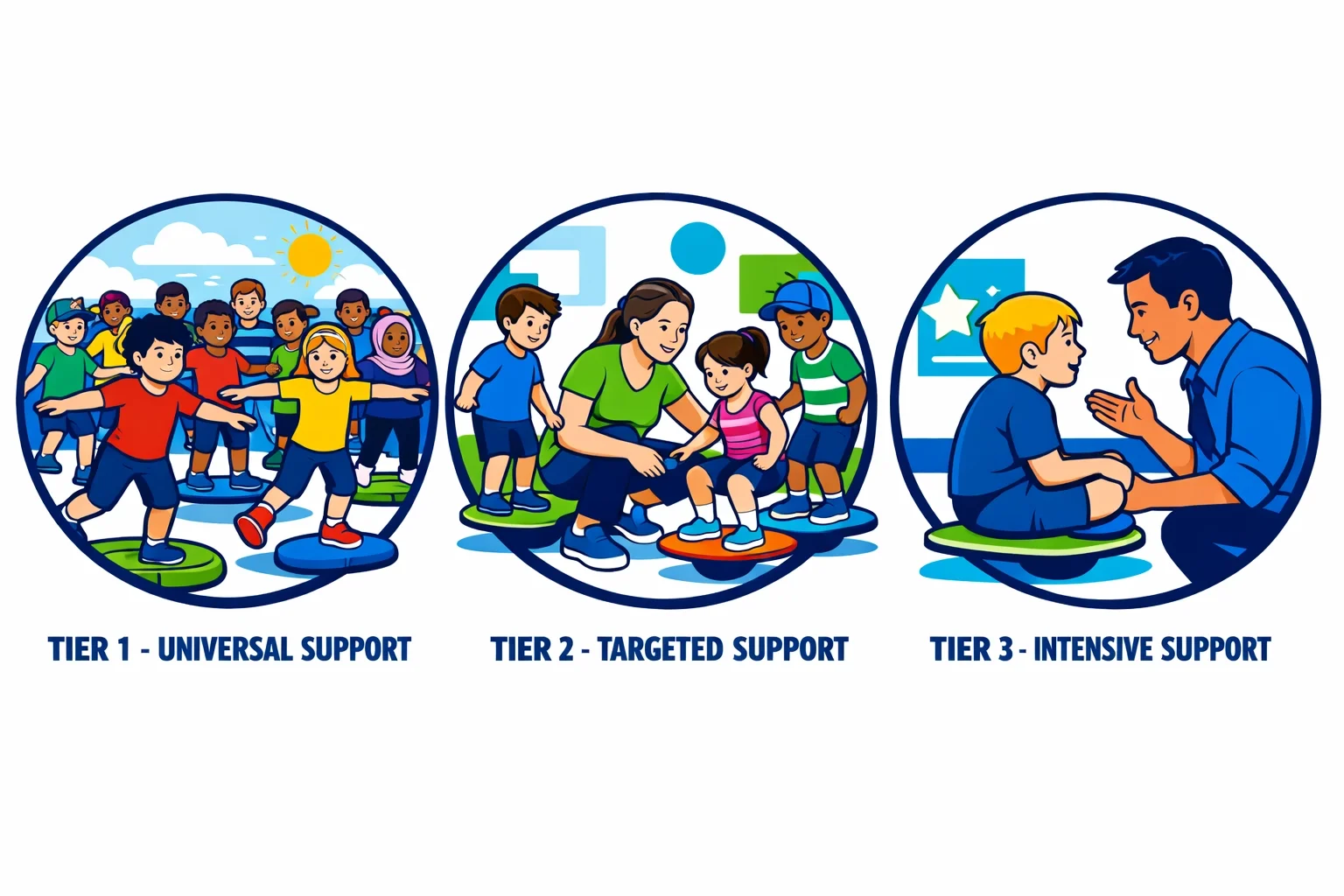
Here's how a mobile after school wellness program like KV33 Swell supports all three tiers of your MTSS framework:
Tier 1: Universal Support (All Students)
Offer balance training as part of a wellness day, PE enrichment, or recess alternative
Use our CREATE Track to teach regulation tools to an entire grade level
Host a quarterly "SwellSync experience" where every student gets exposure to movement-based SEL
Tier 1 ROI (the numbers admins care about)
If you're building a Tier 1 case, you need outcomes and ROI—not just good vibes.
A benefit-cost analysis from Columbia University’s Teachers College (Center for Benefit-Cost Studies of Education) found an average return of $11 for every $1 invested in high-quality SEL programs. Source: https://static1.squarespace.com/static/583b86882e69cfc61c6c26dc/t/59089094cd0f6810013b15ff/1493733525917/SEL-Revised.pdf
A major meta-analysis of school-based universal SEL programs found students showed an average 11 percentile-point gain in academic achievement compared to controls. Source: https://pubmed.ncbi.nlm.nih.gov/21291449/
That’s why we position our work as Tier 1-friendly, prevention-forward SEL enrichment that’s engaging enough for real participation—and structured enough to justify budget decisions.
Tier 2: Targeted Intervention (At-Risk Groups)
Create a 6-week small-group series for students who struggle with self-regulation, focus, or peer connection
Use our HARMONY Track to build social skills in a low-pressure, high-support environment
Partner with your counselor to identify students who would benefit from movement-based regulation strategies
Tier 3: Intensive Support (Individual Students)
Offer private or semi-private sessions for students with IEPs, 504 plans, or behavioral intervention plans
Use balance training as a calm-down tool during crisis moments or sensory breaks
Collaborate with your campus mental health team to integrate movement into existing support plans
The beauty of this model? It's preventative, not reactive. Instead of waiting for students to hit crisis mode, you're giving them tools they can use every single day, in a format that feels fun, not clinical.
What Your Campus Receives When You Partner With KV33 Swell
We get it, you need more than "this sounds cool." You need to know exactly what you're getting, how it fits into your schedule, and whether it's worth the investment.
Here's What's Included:
All equipment and safety gear (helmets, pads, balance boards, surfskates, sound bowls)
Founder-led facilitation with a trauma-aware, safety-forward approach
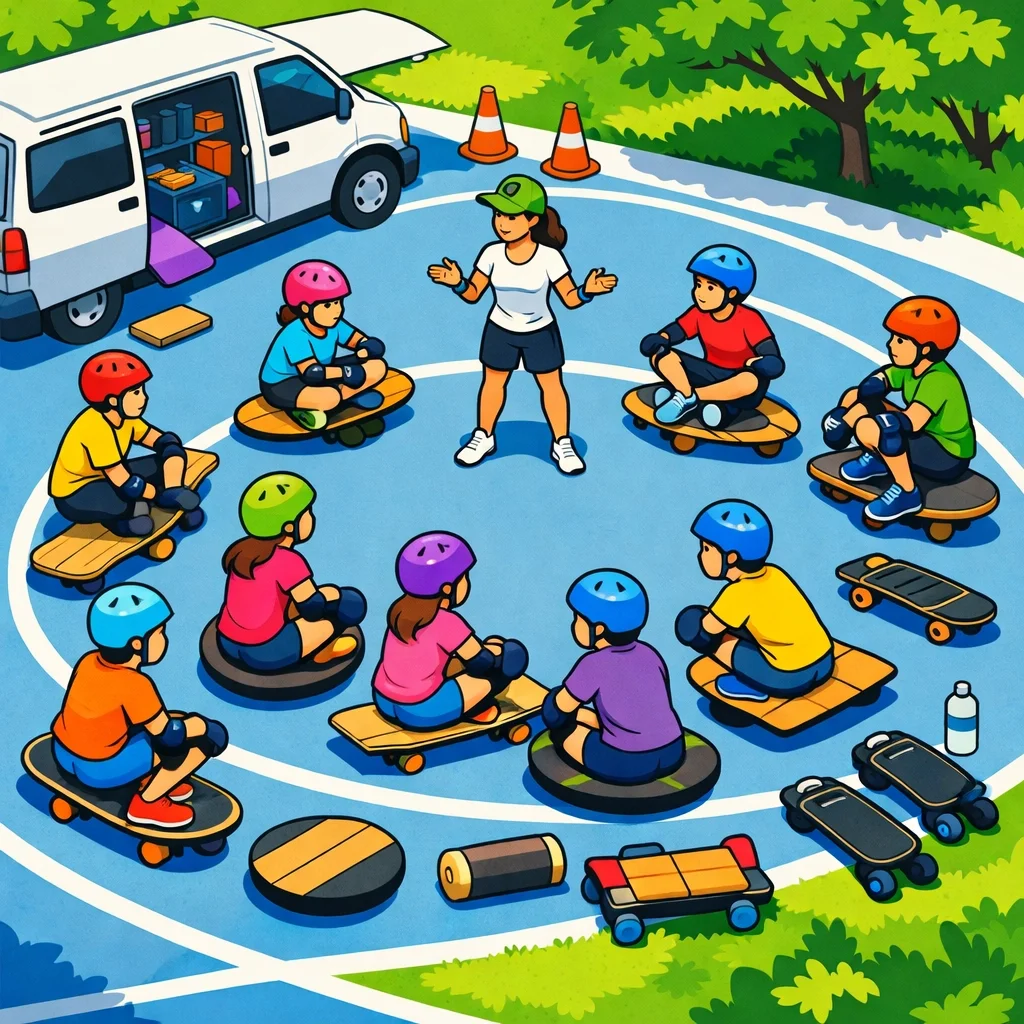
Small group sizes (typically 6–12 students per session for quality mentorship)
Flexible scheduling (we come to you, before school, during PE, after school, or during enrichment blocks)
Pilot program options so you can test the program before committing to a full semester
What a Pilot Looks Like:
Most schools start with a 4-session pilot (one session per week for a month) with 8–10 students. This gives you time to see student engagement, collect informal feedback from teachers, and measure whether students are using regulation strategies outside of sessions.
We also provide a simple pre/post reflection tool so you can track outcomes like confidence, peer connection, and self-regulation, without adding another assessment to your plate.
Serving Austin and Central Texas
KV33 Swell is proud to serve campuses and community spaces across Austin and the greater Central Texas region, including:
Travis County: Austin (78701, 78702, 78703, 78704, 78705, 78731, 78735, 78741, 78745, 78746, 78748, 78749, 78756, 78757, 78758, 78759), West Lake Hills, Lakeway, Bee Cave, Pflugerville, Manor
Williamson County: Round Rock, Cedar Park, Georgetown, Leander, Liberty Hill, Hutto, Taylor
Hays County: Buda, Kyle, Dripping Springs, Wimberley, San Marcos
Bastrop County: Bastrop, Elgin, Smithville
We bring the program to you, whether you're a public school, private school, charter, homeschool co-op, or alternative learning environment. If you have space (a gym, cafeteria, outdoor court, or covered pavilion), we can make it work.
Frequently Asked Questions
What ages do you serve?
We work with youth ages 5–17. Sessions are adapted based on developmental stage, with younger students focusing more on play-based movement and older students exploring deeper SEL concepts and optional sound immersion.
How many students can participate in one session?
Our typical group size is 6–12 students to ensure quality mentorship and individual attention. For campus-wide wellness events, we can accommodate larger groups with modified programming.
What safety measures are in place?
Every student wears a helmet and protective pads (wrist guards, knee pads, elbow pads). We bring all safety gear with us. Our founder is trained in trauma-aware facilitation and maintains small group sizes to prioritize both physical and emotional safety.
Do students need prior experience with skateboarding or balance boards?
Not at all. Our program is 100% beginner-friendly. We start with stationary balance and build gradually. Students of all ability levels and coordination skills can participate and succeed.
Where do sessions take place?
We're fully mobile and come to your campus. We can use a gym, cafeteria, outdoor basketball court, covered pavilion, or any flat, open space. We bring all equipment and set up/break down at no extra cost to you.
What about students with sensory sensitivities or special needs?
We take a universal design approach and offer accommodations like modified movement options and sensory-friendly pacing. Many students with ADHD, autism, anxiety, and sensory processing differences thrive in our program because it's movement-based and non-academic.
How do we request a pilot program?
Visit our contact page at www.kv33swell.org to schedule a 15-minute call. We'll discuss your campus needs, student population, scheduling preferences, and pilot options.
What does sponsorship or funding support?
Sponsorships and donations fund equipment purchases, safety gear, subsidized access for Title I schools or under-resourced students, and program delivery costs. Corporate and community sponsors often fund an entire series for a campus or after-school program.
How are sponsors recognized?
Sponsors receive recognition on our website, in partner communications (with your approval), and in impact reports. We can also collaborate on social media shout-outs, co-hosted community events, or employee wellness experiences as part of larger partnership packages.
What's your content and privacy policy?
We do not post photos of students without explicit written parent/guardian consent. We do not share real-time locations of sessions. All content featuring youth is approved by parents and campus administrators before being used in marketing or social media.
Can we book a recurring after-school series?
Yes! Many campuses partner with us for a full semester or school year. We offer weekly or bi-weekly sessions, typically 45–60 minutes per session. Recurring partnerships receive priority scheduling and discounted rates.
Can parents book private sessions for their child?
Absolutely. We offer private and semi-private youth sessions (ages 5–17) for families who want individualized support. Visit www.kv33swell.org/private-sessions to learn more and request availability.
What Sponsorship and Donations Fund
When a business, nonprofit, or individual sponsors a KV33 Swell series, here's exactly what that funding makes possible:
Equipment and safety gear (balance boards, surfskates, helmets, pads, sound bowls, mats)
Subsidized or free access for students at Title I schools, underserved communities, or families experiencing financial hardship
Founder-led program delivery (setup, facilitation, breakdown, and follow-up support)
Trauma-aware training and quality facilitation that keeps group sizes small and mentorship high
Transportation and mobile delivery so we can reach students where they are: not just where resources already exist
Every dollar goes directly into programming. We're a 501(c)(3), which means your sponsorship is tax-deductible and your impact is measurable.
Want to bring KV33 to a school in your community? Sponsor a series here or email us to discuss partnership options.
Ready to Add Movement-Based Emotional Health to Your Campus?
If you're a school administrator, counselor, PE teacher, or after-school coordinator in Austin or Central Texas, here's how to get started:
Step 1: Reach out through our contact page at www.kv33swell.org with your campus name, approximate number of students you'd like to serve, and any scheduling preferences or questions.
Step 2: Schedule a 15-minute call to discuss your campus needs, student population, and whether a pilot program or recurring series makes the most sense.
Step 3: We'll send a simple Pilot Request Form (location, dates, group size, any accommodations needed) and lock in your dates.
It's that simple. No complicated contracts. No multi-month approval processes. Just a quick conversation and a schedule that works for your campus.
Your students deserve a school wellness program that actually works: one that meets them where they are, builds the skills they need, and feels fun instead of forced.
Let's bring balance training, emotional health, and holistic youth development to your campus.
Request a pilot program today or book a call to learn more about bringing KV33 Swell to your school.
Options:
Bring KV33 to Your School
Sponsor a School Series
Learn About Partnership Options
Schedule a Campus Visit
Get Pricing for Your District
